Cash-Pay Total Knee Replacement Costs in Kansas City

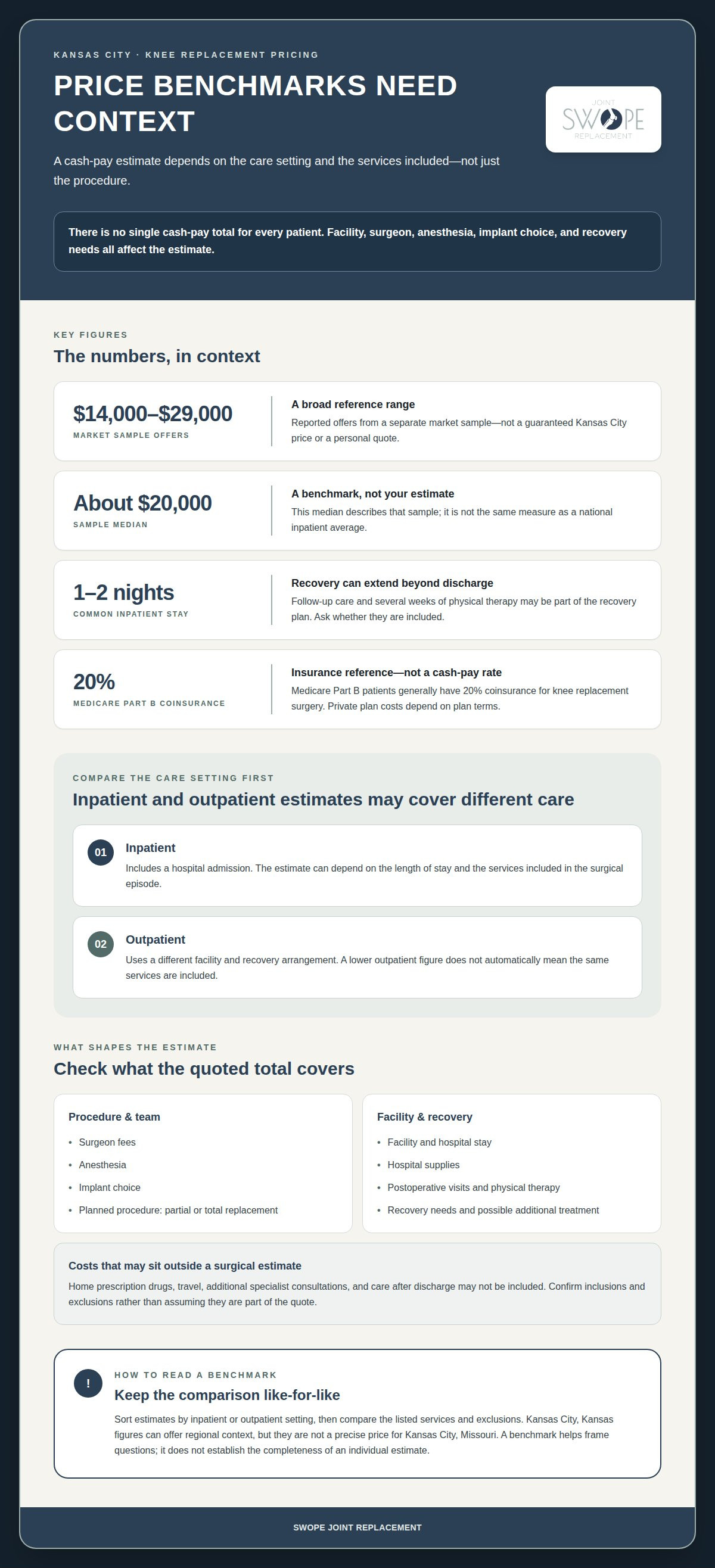
In Kansas City, the cost of total knee replacement without insurance depends on the surgical setting and what the estimate includes. There is no single cash-pay total for every patient. Facility, surgeon, anesthesia, implant, and recovery arrangements all affect the overall expense.
It’s reasonable to want a clear figure before deciding about surgery. It’s just as important to know whether an estimate covers the full episode of care or only part of it, since the setting can affect which services are included.
This guide explains how inpatient and outpatient knee replacement pricing compares in Kansas City and what can affect an uninsured patient’s cash-pay costs. You’ll see which parts of care to look for in a bundled price, how recovery needs fit into the estimate, and what to consider when planning your next step.
Table of Contents
How Much Does a Knee Replacement Surgery (inpatient) Cost?
An inpatient estimate depends on the hospital stay and the services included in the surgical episode. For uninsured patients, the cost of total knee replacement without insurance in Kansas City depends on the case and is given after a quote request; factors include the facility, surgeon, anesthesia, implant choice, and recovery needs.
Insurance Coverage and Out-of-Pocket Costs
Insurance changes how the bill is divided, not which services your surgery requires. Medicare Part B patients generally have 20% coinsurance for knee replacement surgery, according to the Centers for Medicare & Medicaid Services. Private plans have their own deductibles, coinsurance, exclusions, and out-of-pocket limits, so the amount you owe depends on your plan’s terms.
Separate hospital and physician charges in the estimate, then identify which amounts apply to your deductible, coinsurance, and annual out-of-pocket limit. You’re responsible for costs your plan doesn’t cover and for obtaining any required pre-authorizations or referrals. These details can change your personal expense, even when the procedure and hospital are the same.
Physical Therapy and Recovery Costs
Inpatient knee replacement commonly involves a hospital stay of one or two nights. The discharge plan may include follow-up care and several weeks of physical therapy, with the schedule shaped by your mobility, home support, and recovery progress. Ask whether postoperative visits and therapy are included rather than assuming they’re part of the surgical charge.
Recovery expenses may also include prescription drugs taken at home and practical arrangements after discharge. These costs can fall outside a surgical estimate. Map out the care sequence: hospital stay, discharge, surgeon follow-up, and physical therapy. This helps separate procedure costs from expenses that continue after you leave the hospital.
Factors That Affect Procedure Costs
Implant selection, surgeon fees, facility, anesthesia, and the length of an inpatient stay all affect the estimate. Complications may require additional treatment or a longer stay, adding costs. A partial knee procedure differs from a total replacement, so the planned treatment also matters when reviewing a quote.
Delaying surgery can prolong pain and limit daily activity, while estimates from different providers may cover different services. Compare what each includes, such as hospital care, the surgical team, and recovery services. Cost alone doesn’t show whether estimates cover the same care. Discussing timing also helps you weigh your symptoms, mobility, and the clinical reasons for surgery.
U.S. total knee replacement price range and average
U.S. estimates vary widely, so national figures provide context, not a personal quote. The surgical setting and included services can substantially change the total.
National Price Range and Average
Reported U.S. figures describe different price sets, not one universal cash-pay rate. Compare the same type of procedure and included services before interpreting a difference.
A separate market sample puts typical offers between $14,000 and $29,000, with a median of about $20,000. That sample is not the same measure as a national inpatient average. The gap shows why a quoted price needs context: its facility, surgical team, implant, and care setting affect what the total represents.
Inpatient and Outpatient Pricing
These figures allow a like-for-like setting comparison within that data, but they aren’t a current Kansas City quote. Inpatient pricing includes a hospital admission, while outpatient surgery involves a different facility and recovery arrangement.
A lower outpatient figure doesn’t automatically mean the same services are included. Compare whether each estimate covers the facility, surgeon, anesthesia, implant, and postoperative care. These details help explain why prices for the same procedure can differ.
Price Benchmarks
These labels can help frame a comparison, but they don’t establish the value or completeness of a specific estimate. A facility’s price may reflect a different care setting or package.
Use benchmarks to guide questions about an estimate, not as a substitute for its details. Identify whether the amount is for inpatient or outpatient care, then compare the listed services and exclusions.
Location also matters. Kansas City, Kansas benchmarks provide nearby regional context, but they aren’t a precise price for Kansas City, Missouri. Across the metro area, facility choices and care settings can produce different estimates. The sampled market range of $14,000 to $29,000, with a median near $20,000, offers another reference point, but it is not a guaranteed local price.
For a useful comparison, sort estimates by setting first, then by included services. Keep inpatient averages separate from outpatient prices, and treat regional benchmarks as context rather than a promise. This makes it easier to see what each estimate covers before weighing the total.
Cash-pay pricing information for uninsured patients
Self-pay prices depend on the care setting and what the package includes. For a useful estimate, separate the surgery itself from facility, anesthesia, implant, and recovery charges.
Self-Pay Pricing and Upfront Costs
There isn’t one self-pay amount for every total knee replacement in Kansas City, Missouri. The broad market range discussed above is context; a written estimate should reflect your procedure, facility, implant, anesthesia, and planned recovery. Patients in Kansas City, Kansas, likewise need to distinguish regional benchmarks from an individualized estimate.
Upfront pricing may be bundled or itemized. Review the details to see whether the total includes the facility stay, standard implant, hospital supplies, surgeon, and anesthesia. Even a bundle covering a facility stay of one to three nights may exclude other parts of care.
Facility Packages and Prices
Package prices vary with the facility and included services, so a citywide figure doesn’t tell you which hospital or surgery center offers a particular package. A cash option described in market pricing includes hospital supplies and standard implants; an implant outside the offer may carry an additional surcharge.
That package excludes consultations with other specialists, prescription drugs taken at home, and lodging or travel. These exclusions matter when estimating the full expense. Compare each written package by its included services and exclusions rather than treating the headline amount as the complete cost.
Financial Assistance and Payment Options
Financial assistance, charity care, payment plans, and discounts are separate from a surgical package. Their terms depend on facility policies and individual circumstances. Don’t assume any of these options are included in a cash price; identify the arrangement and the costs it covers.
Request the assistance or payment terms in writing alongside the procedure estimate. This makes it easier to see whether the arrangement changes the amount due upfront, the remaining balance, or neither. Keep the surgical estimate separate from any financial arrangement.
Getting a Written Estimate
Request a written, itemized estimate for the planned total knee procedure. It should identify the facility charge, surgeon and anesthesia fees, implant, hospital supplies, and planned stay. Ask for included services and exclusions, such as home prescriptions or specialist consultations, to be listed separately.
Recovery needs also affect your budget. One market cash-option bundle includes one postoperative surgeon visit and three weekly physical therapy sessions for four weeks. A doctor’s recovery plan can differ, so an estimate is most useful when it reflects the planned care and explains how additional services are billed.
Median cost across local providers
A median is the midpoint of the reported prices: half are lower and half are higher. It offers a local reference for knee replacement surgery, but it isn’t an individual quote or a price specific to Kansas City, Missouri.
This figure describes a group of provider prices, not a standardized package. Estimates may represent different facilities, surgical arrangements, or included services. That distinction matters when estimating your out-of-pocket expense. A median can frame a comparison, but it can’t show whether a specific quote includes the implant, anesthesia, or postoperative care.
Use the median as a starting point for a structured comparison. First, identify whether each estimate is for inpatient or outpatient surgery. Then list included services, such as the facility, surgeon, anesthesia, implant, and recovery care. If one estimate excludes a service included in another, their headline totals don’t cover the same care.
The procedure type must also match. A partial knee replacement isn’t the same operation as a total knee replacement, so its estimate shouldn’t be compared directly with a total-knee median. In the United States, comparisons are more meaningful when the procedure, setting, and package details align. This helps prevent mistaking a regional benchmark for a personal cost.
For a practical review, organize local estimates by provider and setting, then record what each includes and excludes. Note whether the implant and hospital stay are included. Separate those details from recovery expenses that may be billed independently. This makes differences visible without assuming the lowest figure covers the same care.
It cannot determine your final bill by itself. Your estimate reflects the procedure and services planned for your care. Use the 64-provider median as context, then assess each written quote on its own terms.
Outpatient total knee replacement cash pricing
Outpatient cash pricing is for a replacement procedure planned without an overnight hospital stay. The key comparison isn’t just the surgical fee. Check whether the estimate accounts for evaluation, facility services, anesthesia, implant, and recovery needs. It should make clear which services are bundled and which are billed separately.
Preoperative clearance may be included in an outpatient cash package. One described option includes a medical consultant’s clearance and tests: urinalysis, a basic metabolic panel, complete blood count, and electrocardiogram. These steps assess medical readiness before surgery and show why a package’s included services matter when comparing cash prices across settings.
Outpatient surgery doesn’t suit every patient. People under 70 who are in good health and have a safe home recovery environment may be candidates. The surgical team considers health, mobility, and practical recovery arrangements when determining the appropriate setting. An outpatient plan should account for how you’ll leave the surgery center and manage the first stage of recovery.
After outpatient knee replacement, patients spend a few hours in a recovery room while sedation wears off. That’s part of the care pathway, but not the entire recovery plan. Physical therapy, follow-up, and prescriptions may be separate from the procedure price. A clear estimate distinguishes the surgery-day package from later care.
For uninsured patients, “covered” usually means services included in a cash package, not insurance benefits. Check whether the amount includes the facility, surgeon, anesthesia, implant, and postoperative care. If you’re comparing cash with insurance, review your deductible and other plan costs separately. Complications or additional care may also change the services needed beyond the planned procedure.
Use a simple comparison: note the setting, list included services, then record exclusions and recovery arrangements. This avoids treating a lower headline amount as equivalent when it covers less. It also clarifies whether the estimate addresses your expected care or only the surgery-center portion.
For an individualized knee replacement estimate, the price depends on your case and is provided after a quote request; the facility, surgeon, anesthesia, implant, and recovery plan shape it. Request a knee replacement estimate to discuss cash pricing and the planned care.
Swope Joint Replacement: out of network insurance
Swope Joint Replacement provides knee replacement care with cash pricing and out-of-network insurance options. If you’re comparing self-pay costs with possible out-of-network benefits, the practice can help you understand the care and pricing relevant to your situation. The price depends on your case and is provided after a quote request; factors include the procedure, facility, surgeon, anesthesia, implant, and recovery plan.
If you’re planning knee replacement and want to discuss pricing or out-of-network billing, a conversation with Swope Joint Replacement can put the estimate in context with the procedure and services involved.
Contact Swope Joint Replacement to discuss your knee replacement questions and next steps.
Make Your Next Knee Care Decision With Clarity
Understanding the cost of total knee replacement without insurance in Kansas City is one part of planning. Connect the financial decision with your treatment goals, daily activities, and recovery questions. A direct conversation with Swope Joint Replacement can help you understand relevant care options and decide what you’d like to explore next.
Swope Joint Replacement offers Knee Replacement, Direct Anterior Hip Replacement, and Revision Hip Replacement. If knee surgery is under consideration, you can discuss the procedure and available cash-pricing or out-of-network insurance options in the context of your care. There’s no need to make every decision at once. Start with the questions that matter most to you.
Contact Swope Joint Replacement to discuss your knee replacement questions and next steps. A thoughtful conversation can help you move forward with greater clarity and confidence.
Frequently Asked Questions
How can patients benefit from self-pay surgery?
Self-pay can make the financial arrangement easier to understand before treatment, especially when you receive a written estimate with itemized services. It doesn’t automatically mean the overall expense is lower. For the cost of total knee replacement without insurance in Kansas City, compare what each estimate includes and excludes. Swope Joint Replacement provides transparent cash pricing for office visits and in-office procedures; surgeries at hospitals or accredited surgical centers are billed out-of-network.
Why is it so difficult for patients to get an upfront cost for surgery?
An estimate depends on the planned procedure, care setting, and services billed separately. The surgeon’s plan may determine which implant, anesthesia, and facility services apply. Request an itemized breakdown tied to the proposed procedure, then ask how changes to the surgical plan affect charges. This helps distinguish an initial estimate from the final set of bills.
What other costs should I worry about?
Consider expenses beyond the operating room, including imaging, medicines, physical therapy, follow-up visits, transportation, or help at home. The care plan determines whether imaging is needed and which recovery services apply. List each expected service separately, then note whether it appears in the surgical estimate or is billed separately. This can help prevent overlooked costs from disrupting your recovery arrangements.
What should be included in the cost?
A useful estimate identifies the surgeon’s work, facility services, anesthesia, implant, and any included hospital supplies. It should also state whether follow-up care or rehabilitation is included. Look for clear descriptions rather than broad labels such as “surgery package.” Record excluded services separately to understand the financial scope of planned care before agreeing to the procedure.
What is included in a total knee replacement cash price or bundled quote?
A bundled quote groups specified services into one amount, but contents vary. The written description should identify the facility, surgical team, anesthesia, implant, and any included postoperative care. It should distinguish routine included items from services that could be billed separately if your care needs change. Review the complete package, not just the headline amount, to understand what it covers.
How much do surgeon, hospital, anesthesia, and implant fees add to knee replacement costs?
There isn’t one fixed amount for each component across all procedures. Surgeon, hospital, anesthesia, and implant charges depend on the facility, the selected implant, and the arrangement for the surgical episode. Request an itemized estimate that separates these categories. For hospital or accredited surgical-center surgery billed out-of-network, the No Surprises Act requires insurers to apply the same deductible and cost-sharing structure as in-network when out-of-network benefits exist.
What extra costs should uninsured patients budget for, including imaging, medications, physical therapy, and follow-up care?
Budget for services that may fall outside the surgical quote, such as imaging, prescriptions, physical therapy, and postoperative visits. The treatment plan determines which services are needed and how they’re billed. Ask the estimate to separate preoperative services from surgery-day care and later recovery. A written list of included and separate items helps you plan costs without assuming every recovery expense is part of the procedure price.



Comments