Hip Replacement Second Opinions in Kansas City: Coverage and Preparation

A second opinion for hip replacement surgery in Kansas City gives you another specialist’s assessment before you decide how to proceed. It can confirm or challenge an initial diagnosis and bring other treatment options into the discussion. Seeking another perspective isn’t a vote against surgery; it can help clarify your choices.
It’s understandable to want clarity before a major procedure, especially if you’re uncertain about the diagnosis, the recommendation, or whether surgery is the right next step. Another medical perspective can help you understand the reasoning behind your options and prepare for a conversation with your current doctor.
This guide explains what a second opinion involves, how to prepare records and questions, and how to check insurance coverage. You’ll also learn what to consider when choosing a hip specialist and how to discuss the assessment with your current doctor, so you can make an informed decision at a pace that feels right for you.
Table of Contents
Insurance coverage for second opinions
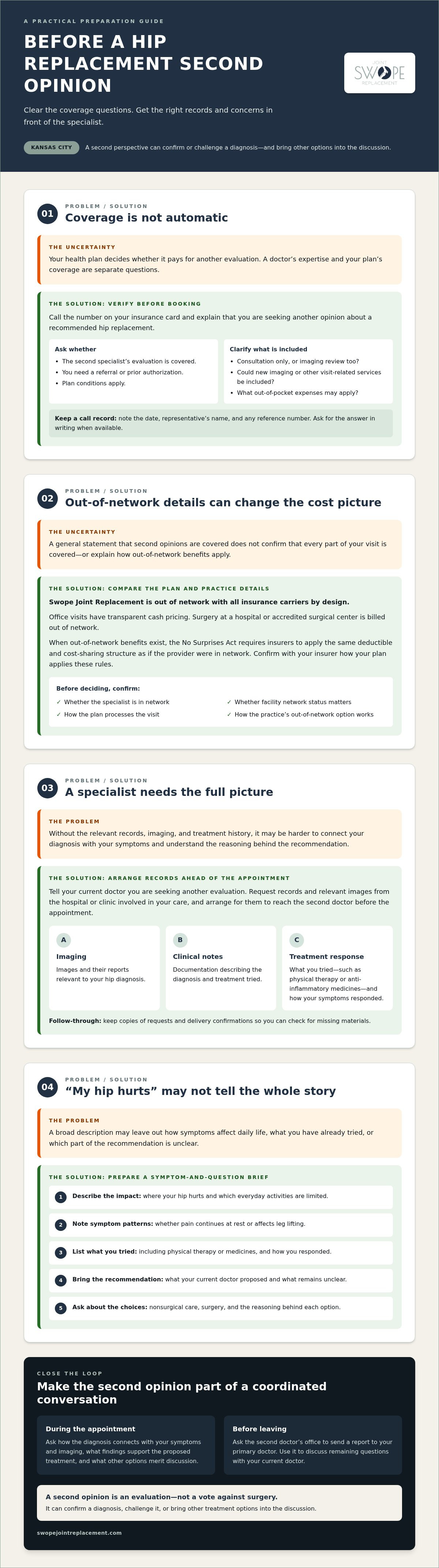
Coverage for a second opinion isn’t automatic. Your health plan determines whether it pays for another evaluation, so ask your insurer before scheduling. For a second opinion about hip replacement in Kansas City, confirm both the benefit and the network status of the specialist you plan to see. A doctor’s expertise and a plan’s coverage are separate questions.
Call the number on your insurance card and explain that you’re seeking another opinion about a recommended hip replacement. Ask whether your plan covers a second specialist’s evaluation for this situation, and whether you need a referral or prior authorization. Ask the representative to identify any plan conditions that apply. Record the date of the call, the representative’s name, and any reference number they provide. These details can help you follow up if the answer needs clarification.
Network status matters. Swope Joint Replacement is out of network with all insurance carriers by design. For office visits, the practice offers transparent cash pricing. For surgery at a hospital or accredited surgical center, charges are billed out of network. Under the No Surprises Act, when out-of-network benefits exist, insurers must apply the same deductible and cost-sharing structure as if the provider were in network. Confirm with your insurer how your plan applies these rules.
Clarify what the insurer’s response applies to. Ask whether it covers only the consultation or also imaging review, new imaging, or other services connected with the appointment. If coverage depends on a code or documentation, ask what information is needed. Request the answer in writing when available, and keep it with your appointment notes. Don’t treat a general statement about second opinions as confirmation that every part of a visit is covered.
Before you book, summarize the answers you received:
Does the plan cover a second opinion for the recommended hip treatment?
Is the specialist in network, and does facility network status matter?
Are referral or authorization steps required by your plan?
Which appointment-related services does the coverage answer include?
What patient expenses could apply if the specialist is out of network?
Out-of-network insurance arrangements can differ from in-network coverage. If you’re considering an out-of-network practice, ask your insurer how it processes the visit, then ask the practice how its out-of-network insurance option works. Compare those answers before deciding. This gives you a clearer picture of the financial side without assuming that a second opinion is either covered or excluded.
Medical records and appointment preparation
A medical second opinion is an evaluation by another healthcare provider or specialist. That clinician reviews your diagnosis and may confirm it, challenge it, or discuss other treatment options. A patient might seek another evaluation when the diagnosis feels unclear, the recommended treatment raises concerns, or they want to understand all available options.
Hip replacement may be considered when pain limits everyday activities, continues at rest, restricts leg lifting, or persists despite anti-inflammatory medicines or physical therapy. Nonsurgical options include those medicines and physical therapy; your clinician can discuss how they relate to your pain and disability.
Choosing to delay or decline surgery can mean continuing to live with pain and limitations that affect daily activities. How those symptoms affect your routine is important to discuss when seeking another opinion.
Start by telling your current doctor you’re seeking another evaluation. Request your medical records and relevant images, including materials from any hospital or clinic involved in your care. Arrange for the records to reach the second doctor before your appointment. This gives the specialist time to review the information alongside your account of your symptoms.
Ask for the records connected to your hip diagnosis and treatment. Relevant materials may include imaging and its reports, notes describing the diagnosis, and documentation of treatments you’ve tried. If you’ve had physical therapy or used anti-inflammatory medicines, note what you tried and how your symptoms responded. Keep copies of requests and delivery confirmations so you can follow up on missing materials.
Bring or prepare a clear summary of the concerns you want addressed:
Where your hip hurts and which daily activities are limited.
Whether pain continues while resting or affects leg lifting.
Which treatments you’ve tried, including physical therapy or medicines.
What your current doctor recommended and what remains unclear.
Questions about nonsurgical care, surgery, and the reasoning behind each option.
At the appointment, describe your goals in practical terms. For example, explain which routine tasks have become difficult, rather than saying only that your hip hurts. Ask the specialist to explain how the diagnosis connects with your symptoms and imaging. You can also ask what findings support the proposed treatment and what other options merit discussion.
Before leaving, ask the second doctor’s office to send a report to your primary doctor. Sharing the assessment helps keep your medical information together and supports a coordinated conversation about your next steps. Use that report to discuss remaining questions with your current doctor.
Choosing a fellowship-trained hip specialist
A second opinion is most useful when the specialist’s experience matches your diagnosis. Look for advanced fellowship training in hip arthroscopy, joint replacement, or sports medicine, alongside experience treating similar conditions. These areas of training relate to different hip problems, so match the specialist’s background to the question you need answered. For a joint replacement decision, ask about experience evaluating hip arthritis and replacement options.
Hospitals and surgeons in the Kansas City area can’t be ranked by location alone. Compare the specialist’s experience with cases like yours, then discuss how the proposed surgical approach, implant selection, and rehabilitation plan relate to your needs. These details help you understand the reasoning behind a recommendation without relying on a broad hospital label.
Use the appointment to explore clinical judgment, not just credentials. Ask the specialist to explain how your symptoms and imaging support the diagnosis. If two doctors recommend different approaches, ask each to describe the expected benefits, limitations, and recovery considerations for your particular case. Clear explanations let you compare recommendations using the same questions.
Your diagnosis also shapes which expertise matters most. If you’re considering joint replacement, focus on the surgeon’s training and experience in that procedure. Someone with a prior hip procedure may need a specialist familiar with complex cases. The right fit is the one whose background addresses the decision in front of you, not simply the broadest list of credentials.
What fellowship training relates directly to my hip diagnosis?
How often do you evaluate patients with a similar condition?
Which surgical approach and implant options are relevant to my case?
What would rehabilitation involve, and how does it connect to my goals?
What findings might support nonsurgical care instead of surgery?
Listen for a specific explanation connecting the diagnosis, treatment options, and your daily limitations. A specialist should be able to discuss the reasoning behind a recommendation in language you understand. You can also ask how the proposed plan accounts for your goals, such as walking comfortably or returning to a valued activity.
After the consultation, compare the recommendations side by side. Note where the specialists agree, where their assessments differ, and which questions remain unanswered. A written report can help you review those points with your current doctor. That conversation keeps the decision focused on your diagnosis, treatment choices, and priorities.
How to find another doctor
Start with the question you want answered. You may want confirmation of an arthritis diagnosis, a clearer explanation of surgery, or another view of nonsurgical options. A focused purpose helps you identify a physician whose experience fits the issue, rather than choosing solely by location or a broad specialty label.
For a hip replacement decision, look for an orthopaedic specialist with advanced training in joint replacement, hip arthroscopy, or sports medicine, and experience treating similar diagnoses. The relevant background depends on your case. A question about replacement planning calls for expertise related to joint replacement; a concern after an earlier hip procedure may call for experience with complex hip cases.
Consider whether another clinician can offer an independent perspective on your current doctor’s recommendation. You can ask your primary care doctor to suggest a surgeon or specialist who doesn’t work with your current surgeon. The goal is an additional clinical perspective, not a contest between doctors. You remain free to compare the explanations and decide what questions need further discussion.
If you’re uncomfortable asking your doctor for a referral, your health insurer can explain which specialists are in network. A local medical society or a nearby university hospital may also help you identify physicians by specialty. These routes can help you build a list; the next step is matching a specialist’s experience to your diagnosis and the decision you face.
Review each candidate’s professional background for training relevant to your hip concern. Fellowship training in joint replacement, hip arthroscopy, or sports medicine can indicate focused study in that area. Then consider whether the specialist treats patients with conditions like yours. The combination matters: a credential alone doesn’t tell you how closely the doctor’s experience fits your situation.
A different professional background may add a useful perspective. For example, if your current specialist has focused on one treatment approach, another clinician with experience in a related area may help clarify the alternatives. The aim is to understand the diagnosis and available paths, not to seek agreement with a preferred answer.
Before scheduling, write down what you need from the visit. Your list might include whether the diagnosis explains your symptoms, what supports the proposed surgery, and which alternatives merit discussion. Share that purpose when arranging the appointment, so the office understands the evaluation you’re seeking.
After choosing a specialist, plan for the consultation to inform a shared decision. Ask for a clear explanation of the findings and treatment reasoning. Then discuss the assessment with your current doctor, noting where the opinions align and where questions remain. That comparison can help you decide what information matters most for your next step.
What medical records and imaging should I bring for a hip replacement second opinion?
Bring the records that show how your hip problem was evaluated and treated. Start with the medical notes related to your diagnosis, relevant hip images, and the reports that interpret those images. Together, these materials help the specialist review what has already been considered and connect that information with your current concerns.
Images and image reports serve different purposes. The images show the hip; the report records the interpretation from the original evaluation. Bring both when available. If the images are stored digitally, find out how to access or share the files before your appointment. A report without its corresponding images may leave part of the original evaluation unavailable for review.
Organize the materials by source, such as a hospital, imaging facility, or treating office. Use a folder or a clearly named digital folder for each location. Keep the date and type of document visible when you can. This makes it easier to distinguish one evaluation from another, especially if you have had imaging or treatment at several locations.
Gather the documents most relevant to your hip assessment:
Medical notes describing the diagnosis and the treatment recommendation.
Relevant hip images and the reports interpreting those images.
Records about treatments already tried, such as physical therapy or anti-inflammatory medicines.
A personal note describing your symptoms, daily limitations, and questions.
Contact details for the facilities holding records you’re still gathering.
Your own notes can fill in details that clinical documents may not capture. Write down where pain occurs, what activities make it harder, and how symptoms affect a typical day. For example, note whether walking, resting, or lifting your leg changes what you can do. Include questions about the diagnosis, the recommended procedure, and alternatives you want discussed.
Before the visit, put the most recent diagnosis and recommendation at the front of your folder. Keep older records behind them in date order. This simple arrangement gives the specialist a clear starting point while preserving the history needed to understand earlier decisions. Bring the complete set, not only documents that seem to support one particular conclusion.
Arrange for the second doctor to receive your records and relevant images before the appointment. If a document is delayed, note which facility holds it and what remains outstanding. At the visit, mention any missing material so the specialist understands the available record. Afterward, ask the second doctor’s office to send its report to your primary doctor, keeping the assessment connected with your ongoing care.
Preparing your records can make the discussion more focused. Discuss your hip replacement questions with a specialist and bring the materials that help explain your diagnosis.
Swope Joint Replacement: Direct Anterior Hip Replacement
Swope Joint Replacement offers Direct Anterior Hip Replacement for patients considering surgery after reviewing their diagnosis and options. If your second opinion confirms that replacement merits discussion, this approach can be part of a conversation about your care. Bring your questions, relevant records, and imaging so the specialist can consider your findings and priorities together.
A second opinion doesn’t require you to set aside your current doctor’s advice. It can help clarify the recommendation and give you a focused opportunity to discuss whether hip replacement fits your needs. Swope Joint Replacement also provides Revision Hip Replacement for patients facing complex follow-up needs after a previous hip replacement.
For a thoughtful discussion of hip replacement options, contact Swope Joint Replacement.
Choose your next step with confidence
A second opinion can help you decide what questions still need answers before choosing a treatment path. Use the discussion to weigh the medical recommendation against your priorities, daily life, and comfort with the proposed plan. You don’t need to treat another evaluation as a commitment to surgery. It can be part of a careful, informed decision.
If you’re considering a second opinion for hip replacement surgery in Kansas City, Swope Joint Replacement offers Direct Anterior Hip Replacement, Knee Replacement, and Revision Hip Replacement. These services connect the practice’s orthopaedic care to patients considering joint replacement or facing a complex revision decision.
Bring forward the questions that matter most to you, and make space for a clear conversation about your options. Contact Swope Joint Replacement to discuss your next step. You can move forward at a pace that feels considered and right for you.
Frequently Asked Questions
What is a Second Opinion?
A second opinion is another healthcare provider’s assessment of your diagnosis or proposed treatment. It can confirm the original recommendation, offer a different interpretation, or identify options for discussion. For example, if one surgeon recommends hip replacement and you’re unsure why, another specialist can review the clinical reasoning and explain what considerations inform the recommendation. The purpose is to help you make a more informed decision, not to require a different answer.
How Much Does It Cost?
The cost depends on what the appointment involves, including whether it is an office consultation or includes additional services. For a self-pay office visit, Swope Joint Replacement provides transparent cash pricing. Ask for the applicable quote before arranging care, and clarify which services it covers. If you plan to use insurance, ask your insurer about coverage and network status separately; coverage for an evaluation and related services can depend on your plan.
Where can I get a second opinion for hip replacement surgery in Kansas City?
Look for an orthopaedic specialist whose training and experience relate to hip replacement. Swope Joint Replacement provides Direct Anterior Hip Replacement care in Overland Park and the greater Kansas City area, including Olathe, Lee’s Summit, Lenexa, Leawood, Blue Springs, and Independence. You can explore whether its hip replacement care fits the questions you want to discuss during another evaluation.
How do I prepare for a hip replacement second-opinion appointment?
Along with your records and imaging, prepare a brief timeline of your hip symptoms and prior evaluations. Note when pain affects activities, what treatments you’ve tried, and what changed afterward. Write down the decision you’re facing, such as whether to consider surgery now or discuss another approach. This focused summary can help keep the appointment centered on your circumstances and the questions you still need answered.
Does insurance cover a second opinion before hip replacement surgery?
Coverage depends on your health plan, so ask your insurer whether the evaluation is covered and whether referral or authorization steps apply. Swope Joint Replacement is out of network with all insurance carriers by design. Office visits have transparent cash pricing. Surgeries at a hospital or accredited surgical center are billed out of network; when out-of-network benefits exist, the No Surprises Act requires insurers to apply the same deductible and cost-sharing structure as in network.
What does a self-pay hip replacement second opinion cost in Kansas City?
Swope Joint Replacement offers transparent cash pricing for office visits and in-office procedures, but the applicable amount depends on the services involved. Ask for a quote for the evaluation itself, and clarify whether any additional services are separate. Surgery is billed out of network, so a self-pay office visit and a surgical bill are different parts of the financial conversation. No specific amount should be assumed before receiving the relevant quote.
Which Kansas City orthopedic surgeons specialize in hip replacement second opinions?
Dustin Woyski completed a hip preservation and reconstruction fellowship and accepts complex hip cases, including failed hip arthroscopies, and performs hip replacement on young adults. Ask whether his experience matches your diagnosis and treatment question.



Comments