Private Knee Replacement Surgery and Recovery in Overland Park

A knee replacement doesn’t always require an overnight hospital stay. Eligible patients having outpatient total knee replacement may go home the same day. The procedure removes damaged cartilage and bone and replaces the joint surfaces with artificial components. A private knee replacement surgeon in Overland Park can explain whether this approach suits your needs and what to expect.
It’s natural to want clear answers before considering surgery, from what an implant is made of to how recovery may affect your routine. Understanding the procedure, its potential risks, and the rehabilitation plan can help you make a more informed decision.
This guide covers knee implant components, outpatient care, recovery, and possible complications, along with the Overland Park clinic location. You’ll also learn what to expect from the surgical process and the factors that shape an individualized care plan.
Table of Contents
Surgical procedure and implant components
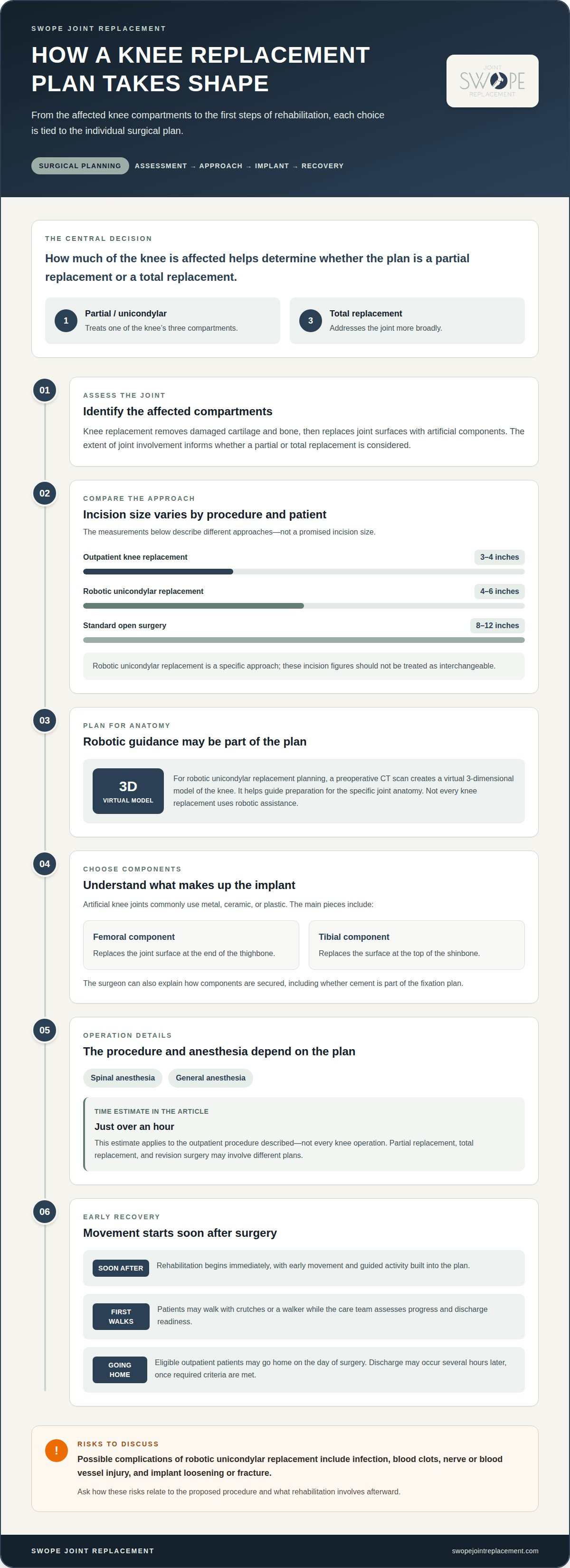
Knee replacement removes damaged cartilage and bone, then replaces the joint surfaces with artificial components. Because the knee has three compartments, the surgical plan depends on how much of the joint is affected. A partial, or unicondylar, replacement treats one compartment; a total replacement addresses the joint more broadly. The planned procedure influences the incision, implant choice, and rehabilitation discussion.
Incision size varies by procedure and patient. Outpatient knee replacement may use an incision measuring three to four inches, while standard open surgery is described with an eight- to twelve-inch incision. Robotic unicondylar replacement uses an incision measuring four to six inches over the knee. These figures describe different approaches, not a promised incision size. Ask how the proposed approach relates to your joint damage and implant plan.
Robotic assistance can support planning before the operation. A preoperative CT scan creates a virtual 3-dimensional model of the knee for robotic unicondylar replacement planning. That model helps guide the surgeon’s preparation for the specific joint anatomy. It does not mean that every knee replacement uses robotic assistance. In a consultation, clarify whether the plan is partial or total, whether robotic guidance is involved, and why that approach suits the affected compartments.
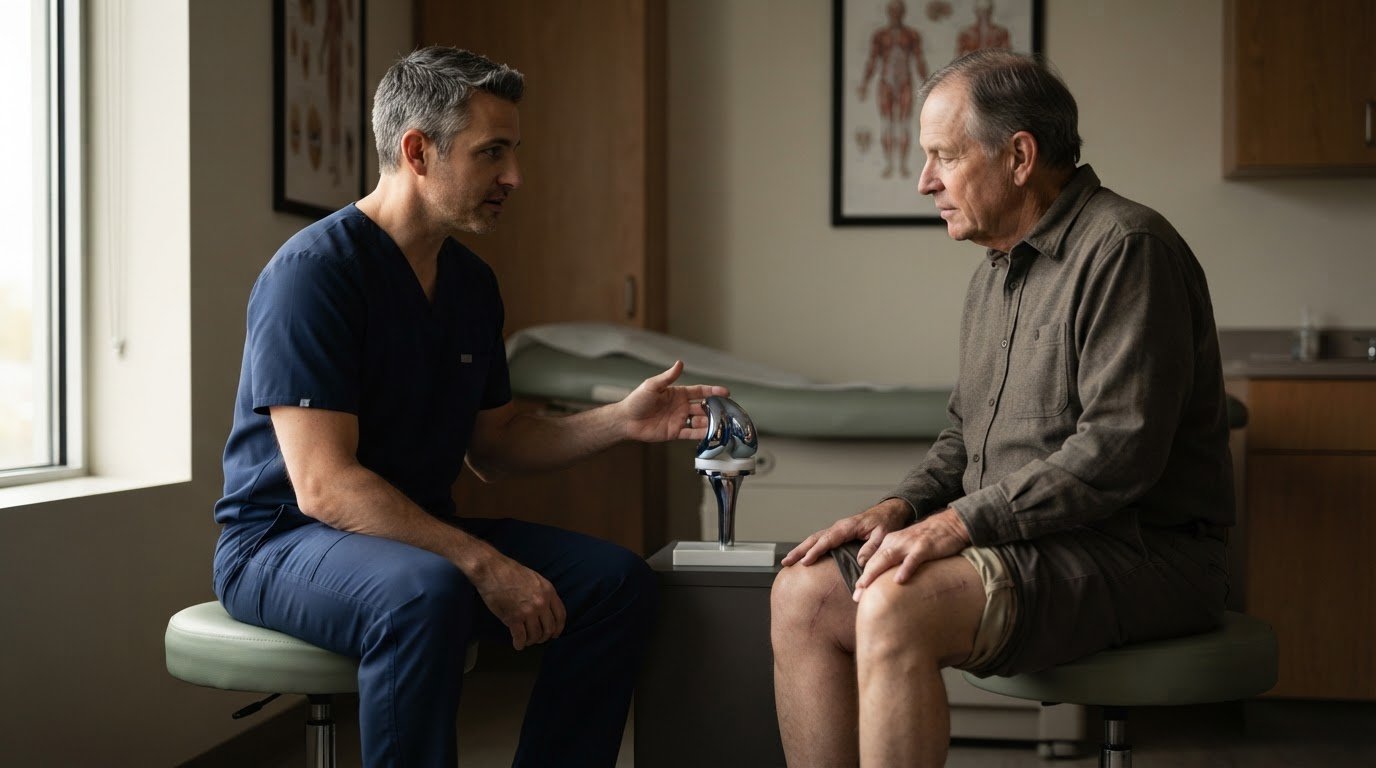
Artificial knee joints commonly use metal, ceramic, or plastic. The main pieces include a femoral component, which replaces the joint surface at the end of the thighbone, and a tibial component, which replaces the surface at the top of the shinbone. Your surgeon may also explain how the components are secured, including whether cement is part of the fixation plan. Ask which materials and components are proposed and how they relate to your imaging and surgical goals.
The outpatient procedure described takes just over an hour. That estimate applies to the procedure described, not every knee operation. The plan may differ for partial replacement, total replacement, or revision surgery. Revision surgery replaces part or all of an existing prosthesis, so the surgeon evaluates the implant and the work required. These distinctions help you compare plans without treating one time estimate as a personal forecast.
Possible complications of robotic unicondylar replacement include infection, blood clots, nerve or blood vessel injury, and implant loosening or fracture. Discuss how these risks apply to the proposed procedure and what rehabilitation involves afterward. Clear answers about the incision, components, robotic planning, and risks can help you evaluate a private knee replacement surgeon in Overland Park.
Outpatient total knee replacement
Outpatient total knee replacement allows eligible patients to go home on the day of surgery. The procedure replaces damaged knee joint surfaces, and rehabilitation begins soon afterward.
Surgeon Reviews and Outcomes
When reading reviews, look for details about the full care experience, not just a star rating. Specific accounts may describe the consultation, explanations of the surgical plan, discharge preparation, and rehabilitation support. Reviews reflect individual experiences and don’t predict your result. Ask how the surgeon follows progress after total knee replacement and what informs follow-up care.
When comparing surgeons in Overland Park, consider patient feedback alongside their approach to the specific procedure and follow-up care. Give more weight to information about the operation you’re considering: total replacement and revision surgery involve different needs.
Surgeon Specialization and Experience
For private knee replacement, look for an orthopaedic surgeon whose practice includes knee replacement and whose experience fits the proposed operation. Ask about primary total replacements and revision procedures if you already have an implant. These are distinct operations: revision surgery replaces part or all of a previous prosthesis and may involve additional work to address lost bone.
Review qualifications and experience in the context of your specific treatment plan. A surgeon should be able to explain why total replacement is being considered, how the procedure addresses your joint, and what rehabilitation follows. The information available here identifies no individual surgeon by name, so this comparison focuses on relevant specialization and the questions your consultation should answer.
Insurance Coverage and Network Participation
Private health insurance coverage depends on your plan’s benefits and terms. Network participation also depends on the relationship between your plan and the surgeon’s practice. For out-of-network care, review how your policy handles the surgeon and related surgical services; coverage and patient responsibility can differ by plan.
Which surgeons are in network in Overland Park? That depends on your specific insurance plan, so a surgeon’s location alone doesn’t establish network status. Swope Joint Replacement works with out-of-network insurance, not in-network billing. Confirming the distinction in your policy helps you understand the financial arrangements before choosing a surgical plan.
Procedure and Revision Considerations
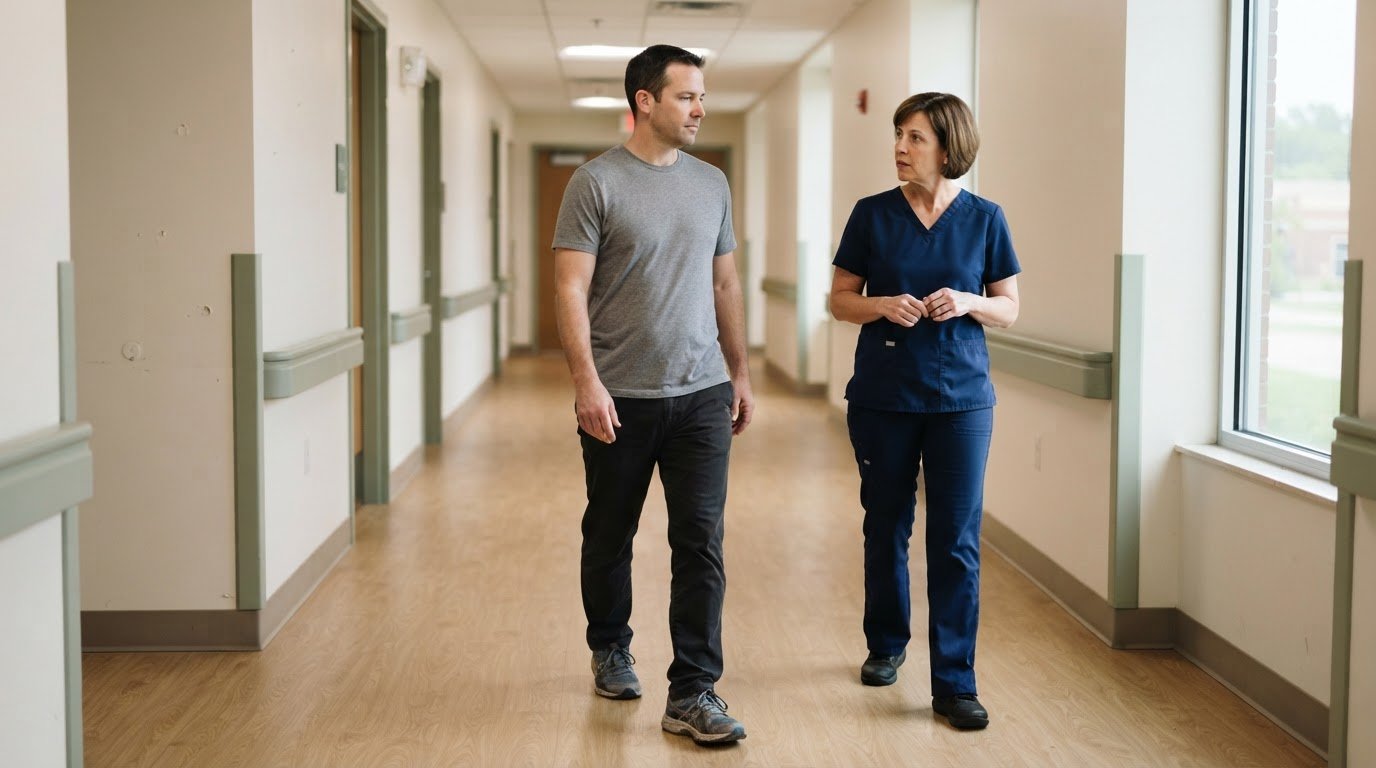
During total knee replacement, the surgeon removes damaged cartilage and bone, then places artificial components to restore the joint surface. The procedure uses spinal or general anesthesia. Afterward, patients may walk with crutches or a walker as the care team assesses progress and readiness for discharge.
Outpatient care means eligible patients may go home on the day of surgery. Discharge may occur several hours later once the required criteria are met. Rehabilitation begins immediately after surgery, with early movement and guided activity built into the plan. Ask how your first walks and recovery at home will be organized.
Revision total knee replacement addresses an existing prosthesis rather than an untreated joint. The surgeon may replace one component or all of them; lost bone may require a metal wedge or bone graft. Patients may use crutches or a walker afterward and begin rehabilitation within a couple of days. These details distinguish revision planning from primary outpatient replacement.
Hospital stay and recovery
Recovery after knee replacement starts with early movement, not a long period of complete rest. Rehabilitation after total knee replacement begins immediately after surgery. Your care plan may include walking practice, guided exercises, and equipment that supports controlled knee motion. Knowing these first steps helps you plan the transition from the surgical setting to home or rehabilitation care.
Hospital stay depends partly on the type of procedure and how recovery progresses. Robotic unicondylar knee replacement may involve a hospital stay of 1-3 days. A patient may leave the same day if the doctor considers recovery satisfactory. Outpatient total knee replacement also allows eligible patients to go home on surgery day, with discharge possible several hours after surgery when requirements are met.
Early mobility is a practical part of recovery. After total knee replacement, patients may walk with crutches or a walker. A continuous passive motion machine moves the knee through a controlled range while you rest. These tools have different purposes: walking aids support mobility, while the machine moves the joint. Physical therapy may be recommended after robotic unicondylar replacement.
Recovery time varies by procedure. The described recovery period after outpatient knee replacement is two to four weeks; traditional knee surgery is described as taking two to three months. These timeframes are not interchangeable. Ask which procedure the estimate refers to, which activities it covers, and how rehabilitation fits your plan. Returning to routine tasks and rebuilding knee strength, for example, are different milestones.
Revision knee replacement has its own rehabilitation plan. A physical therapist teaches exercises to strengthen the leg and restore knee range of motion. Knee immobilizers may be used during physical therapy, walking, and sleep to stabilize the knee. Patients may use crutches or a walker, then begin rehabilitation within a couple of days after surgery. These details matter when an earlier implant is being replaced.
For robotic unicondylar replacement, maintaining a healthy weight is advised to minimize stress on the joint. This recommendation connects daily habits with joint loading as rehabilitation progresses. Consider arthritis treatment and joint replacement planning together: surgery addresses damaged joint surfaces, while rehabilitation works on movement and strength. During your consultation, discuss your first days after surgery, mobility aids, therapy plan, and expected milestones.
If you live in Kansas City and plan to receive care in Overland Park, include the trip home in your discharge plan. Arrange who will accompany you and how you’ll manage the ride with a walker or crutches. A written checklist can cover your mobility aid, therapy instructions, and next rehabilitation step. Planning ahead makes the transition from surgical care to recovery easier to manage.
Possible risks and complications
A useful discussion of risks names specific complications rather than relying on general assurances. For robotic unicondylar knee replacement, possible complications include infection, blood clots, nerve or blood vessel injury, and implant loosening or fracture. These are separate concerns. Ask how each relates to the proposed procedure, rather than assuming a minimally invasive approach removes surgical risk.
Infection concerns the surgical site or area around the implant. Blood clots involve clot formation in blood vessels. Nerve or blood vessel injury means harm to structures near the operated knee. Implant loosening or fracture affects the artificial components. These plain-language distinctions can help you understand what your surgeon means when discussing each complication.
The procedure matters. The listed complications relate specifically to robotic unicondylar replacement, which treats part of the knee joint. This risk list should not automatically be treated as complete for every total or revision knee replacement. A total replacement addresses more of the joint, while revision surgery replaces part or all of a prior prosthesis. Ask which risks apply to your proposed operation.
Use planning discussions to raise personal considerations. Bring a clear account of your symptoms, previous knee operations, current treatments, and concerns about damaged joint areas. Ask how imaging informs the surgical plan, whether the proposed approach is partial or total, and how the team addresses the risks relevant to that procedure. Specific answers are more useful than broad assurances about safety.
Also clarify what the surgical team considers during recovery. Ask how the plan addresses blood clot concerns, what follow-up is arranged for the incision, and how implant function is assessed. These questions focus on practical aspects of care without assuming a complication will occur. If you’re comparing approaches, ask whether the potential benefits fit your goals and condition alongside the risks.
A smaller incision does not mean an operation has no possible complications. Incision size describes access to the knee; infection, clotting, nearby structure injury, and implant problems are separate concerns. The label “minimally invasive” alone cannot explain your individual risk profile. Ask the surgeon to connect the planned technique, implant, and care steps to your case in plain language.
Before deciding, write down the answers you receive about each named risk. Note which complications apply to your procedure, how the surgical plan addresses them, and what signs or changes the care team wants you to report. If a term remains unclear, ask for an example involving the knee or implant. A private knee replacement surgeon in Overland Park should be able to discuss these risks directly and explain how they inform your treatment decision.
Overland Park clinic location
The Overland Park clinic is located at 7127 W 95th Street, Overland Park, Kansas 66212. Keep this address separate from the surgical facility: a clinic visit and a knee replacement operation are distinct parts of care. The clinic address identifies where to attend for care, but it does not identify the hospital or surgery center where an operation takes place.
The hospital or surgery center used for a knee replacement depends on the surgical plan. No specific facility names are available here, so don’t assume the clinic address is also the operating location. Before your procedure, make sure your plan clearly identifies where surgery and postoperative care will occur. This distinction matters when arranging transportation, preparing for discharge, or coordinating physical therapy.
Use the street address when planning a visit, rather than relying on a general Overland Park destination. Save the full address in your navigation, allow time to arrive, and bring notes or records relevant to your knee arthritis, previous treatment, or joint replacement questions. For a consultation, write down your priorities, such as pain, movement, cartilage damage, or returning to a specific daily activity.
Clinic hours are listed for Monday from 5:30 PM to 8 PM and Thursday from 9 AM to 5 PM. The clinic is closed Sunday. Use those listed hours when planning a visit, and consider how travel fits with your other appointments, including physical therapy. A simple schedule can help you keep consultations, surgery planning, and rehabilitation steps organized.
Use your visit to clarify the practical sequence of care. Note where the consultation takes place, where the procedure is planned, and how you’ll travel between locations if needed. Ask how early movement begins after surgery and how physical therapy fits into recovery. These details help turn a surgical plan into a realistic schedule for you and anyone supporting your care.
When comparing options in Overland Park, keep a short location checklist: clinic address, operating facility, arrival plan, transportation home, and rehabilitation arrangements. If you expect to use a walker, for example, consider how it affects the ride home. Clear logistics can reduce last-minute confusion without changing the clinical decisions about damaged cartilage or joint function.
For a discussion of knee replacement planning and care, explore knee replacement care and take the next step toward a consultation.
The clinic lists Dr. Paras Shah as having more than 20 years of medical experience. You can use a consultation to discuss your symptoms, prior care, and what you hope to regain in daily movement, while confirming which location applies to each step of the plan. Experience is one consideration to raise alongside the details of your own treatment needs.
Because the clinic is closed Sunday, arrange any visit for a listed open day and confirm the appointment details before traveling. Keep the clinic address and any separate surgical location in your notes, so directions for an office visit are not confused with instructions for the procedure.
Swope Joint Replacement: Direct Anterior Hip Replacement
Swope Joint Replacement offers Knee Replacement for people considering surgery after learning about the procedure, recovery, and possible risks. If an existing knee implant needs attention, Revision Knee Replacement may be relevant. Direct Anterior Hip Replacement addresses a different joint and may be relevant if hip concerns are also part of your care.
A conversation can help you discuss your knee concerns, treatment priorities, and whether primary or revision surgery is relevant. Swope Joint Replacement also works with out-of-network insurance, an important consideration when reviewing your coverage arrangements.
For a personal discussion about knee replacement options, contact Swope Joint Replacement or visit swopejointreplacement.com.
Take the Next Step With Clarity
Your next step can be a focused conversation, not a commitment to surgery. Bring the questions that matter most: what you hope to regain, what concerns you about treatment, and what information would help you weigh your options. A private knee replacement surgeon in Overland Park can discuss how your goals relate to a potential care plan, including whether non-operative treatment or surgery merits consideration.
Swope Joint Replacement offers Knee Replacement, Direct Anterior Hip Replacement, and Revision Hip Replacement. If your consultation concerns knee surgery, keep the discussion focused on your specific concerns and the options before you. Clear explanations can support an informed decision at your own pace.
When you’re ready to take that step, contact Swope Joint Replacement to begin a conversation. You can move forward with a clearer understanding of your options and a plan shaped around what matters to you.
Frequently Asked Questions
What are the risks and complication rates of knee replacement surgery?
Possible complications of robotic unicondylar knee replacement include infection, blood clots, nerve or blood vessel injury, and implant loosening or fracture. Interpret any complication rate in the context of the procedure being considered, because partial, total, and revision replacements are different operations. Ask the surgeon which risks apply to your planned approach and how your health history and treatment plan inform the discussion.
What is the recovery timeline and rehabilitation process after knee replacement?
Recovery depends on the procedure and your progress through rehabilitation. Early therapy focuses on improving knee movement and leg strength safely, with a physical therapist guiding exercises and mobility. Your plan may track, for example, how comfortably you bend your knee and walk with an aid before increasing activity. Ask which milestones will guide your transition from supervised therapy to exercises at home.
Which orthopedic surgeons in Overland Park specialize in private knee replacement?
As a leading private knee replacement surgeon Overland Park patients trust, our team features highly experienced specialists. Scott Abraham has performed more than 100 robotic-assisted partial and total knee replacements. Dr. Terry Presley has performed thousands of robotic surgeries, bringing advanced expertise to joint reconstruction at Swope Joint Replacement.
What hospitals and surgery centers do Overland Park knee replacement surgeons use?
Surgeons at Swope Joint Replacement perform advanced robotic-assisted partial and total knee replacements at premier facilities, including Overland Park Surgical Suites and local outpatient centers equipped for specialized orthopedic care.
Comments