Questions to Ask Your Orthopedic Surgeon About Hip Surgery and Recovery

Choosing a hip replacement plan involves more than the operation itself. The most useful questions to ask your orthopedic surgeon before hip replacement cover whether surgery fits your needs, which approach and implant are recommended, and what recovery may involve. The two most common approaches are posterior and direct anterior.
It’s natural to want a clear picture of what comes next, including how pain will be managed, whether you’ll stay in the hospital, and when you may return to daily activities. Your age, health, lifestyle, and goals all matter, so ask for answers that help you understand your options and make an informed decision.
This guide offers practical questions about preparing for surgery, procedure choices, anesthesia, pain relief, hospital plans, and rehabilitation. It also covers walking, driving, work, and other activities during recovery, so you can focus your appointment on what matters most to you.
Table of Contents
1. Preparing for surgery
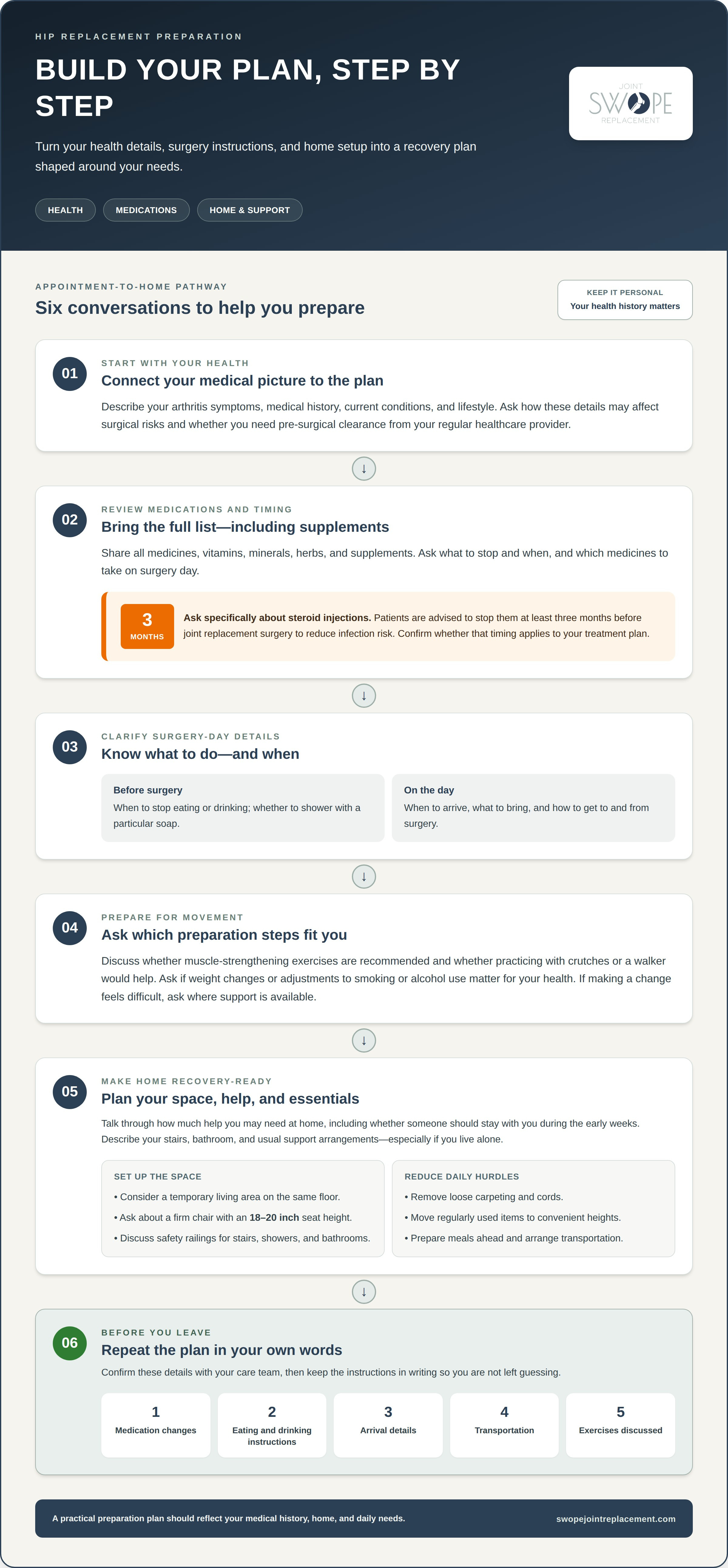
Preparation starts with a review of your health, routine, and recovery needs. Discuss your arthritis symptoms, medical history, current conditions, and lifestyle. Ask how these details affect surgical risks and whether you need pre-surgical clearance from your regular healthcare provider. Share your full medication list, including vitamins, minerals, herbs, and supplements, so your care team can explain what to stop and when.
Be specific about injections. Patients are advised to stop steroid injections at least three months before joint replacement surgery to reduce infection risk. Ask whether that timing applies to your treatment plan. Also ask which medicines to take on surgery day, when to stop eating or drinking, when to arrive, and what to bring. Raise any questions about showering with a particular soap before surgery with your care team.
Ask which preparation steps suit your strength and daily needs. Your surgeon can discuss whether muscle-strengthening exercises are recommended and whether practicing with crutches or a walker would help. Ask whether weight changes or adjustments to smoking or alcohol use matter for your health. If quitting smoking or avoiding alcohol feels difficult, ask where to find support. Your preparation should reflect your medical history, not a generic checklist.
Your home setup can make recovery easier to manage. Ask how much help you’ll need at home and whether someone should stay with you during the early weeks. Discuss a temporary living area on the same floor, a firm chair with an 18 to 20 inch seat height, and safety railings for stairs, showers, and bathrooms. Remove loose carpeting and cords, move regularly used items to convenient heights, and prepare meals ahead. Arrange transportation to and from surgery.
Useful questions to ask your orthopedic surgeon before hip replacement include whether you’ll be able to get out of bed and what supplies you’ll need during recovery. Ask whether another health condition needs attention before surgery and how your care team will coordinate that preparation. If you live alone, describe your stairs, bathroom, and usual support arrangements. These details help shape a practical plan for home and clarify where you’ll need assistance.
Before leaving the appointment, summarize the instructions in your own words. Confirm medication changes, fasting instructions, arrival details, transportation, and the exercises you discussed. A written plan helps you prepare without guessing what comes next.
2. Are all hip replacement techniques the same?
No. The two most common surgical approaches are posterior and direct anterior, and hip implants may use metal, ceramic, or polyethylene components. Ask which approach and implant your surgeon recommends for your anatomy, health, and activity level, and why they suit your treatment goals.
The approach is only one part of the plan. Your surgeon may consider your age, activity level, and general health when discussing whether replacement is appropriate. Ask whether physical therapy, injections, or lifestyle changes could address your symptoms without surgery. If you have arthritis, describe how pain and stiffness affect everyday activities so the discussion reflects your needs.
Surgical planning should include a discussion of risks. Infection, blood clots, and implant issues are potential complications of joint replacement. Ask which risks matter most for your health and what steps may help reduce them. If robotic tools or other planning technology are proposed, ask what role they would play, how the plan is tailored to you, and whether the approach changes any part of recovery. Focus on the expected benefit in your case, not just the technology’s name.
There isn’t one implant or approach that suits every patient. Ask how the recommended procedure relates to your anatomy and activity level, and which alternatives remain reasonable. The explanation should make the trade-offs clear, including why one approach is recommended over another.
Ask how many procedures of the type being considered your surgeon has performed, how often they perform them, and which outcomes they track. These figures and measures are specific to the surgeon and procedure, so ask for them and how they relate to your circumstances. You can also ask how the surgeon handles complications and what follow-up supports recovery.
There is no single cost that applies to every hip replacement. The price depends on your case and is provided after a quote request; ask which care and procedure factors shape it, and how your insurance or Medicare benefits may apply. Swope Joint Replacement offers out-of-network insurance options, so include your plan and coverage questions in the financial discussion.
If a direct anterior approach is being considered, learn about direct anterior hip replacement as one option to discuss alongside your surgeon’s recommendation.
3. Returning to activities
Ask what you can expect to do during recovery and how to build activity back into your routine. Recovery varies, so discuss pain relief, range of motion, activity goals, and work demands with your care team. If golf, swimming, tennis, or hiking matters to you, name those activities. Your surgeon can explain how your treatment plan relates to each one.
Clarify which movements to avoid before and after surgery. One preparation recommendation is not to bend at the waist more than 90 degrees before hip replacement surgery. Afterward, ask whether you should avoid flexing the hip beyond 90 degrees while sitting, crossing your legs, or twisting and pivoting on the operated leg. Deep squats and certain yoga poses can involve extreme positions. Ask how long your own precautions apply.
Activity choices can affect your implant over time. Hip or knee replacements can generally be expected to last 20 years or more, and about 58% of total hip replacements last around 25 years. These figures offer context, not a personal forecast. Ask how implant longevity relates to your anatomy, activity level, and follow-up plan. High-impact activities such as running or jumping are generally avoided after total hip replacement.
Plan rehabilitation around milestones, not a single finish date. Most people can return to light activities about 3 to 6 weeks after surgery, while full recovery can take 3 months to a year. After about three months of strengthening, most people can return to activities such as golfing, gardening, and tennis. Your surgeon can determine how these general timelines relate to your healing and the demands of each activity.
Ask when rehabilitation begins, which exercises to do, and how often you’ll work with a physical therapist. Walking regularly, completing prescribed exercises, and attending therapy can support your progress. Ask whether home-based therapy suits your plan and how the care team will track your mobility and adjust treatment.
Talk through practical return-to-life questions before surgery. Ask when you can drive, return to desk-based work, or resume manual duties; work demands and recovery progress affect those decisions. Most people who have hip or knee replacement surgery are walking without a cane or walker by six weeks after surgery. Ask what signs show you’re ready to move from a walker to a cane, and when to contact your doctor about problems during recovery.
4. Anesthesia, pain management, and hospital stay
Ask what type of anesthesia is planned and whether the options are appropriate for you. Share your medical history, chronic conditions, and current medications with your care team. Ask whether another healthcare provider should assess a condition before surgery. These details help the team plan anesthesia, pain relief, and safe movement after the procedure. Raise any concerns about infection or other surgical risks directly.
Discuss pain management before surgery, not only after discomfort begins. Ask what methods the team plans to use after the operation, how you’ll know when to request help, and which medication instructions to follow at home. Tell your surgeon about medicines you already take and any past difficulty managing pain. A clear plan should explain whom to contact with questions and how pain relief fits alongside physical therapy.
Ask what to expect when you wake up, including how the team will assess pain and help you start moving. Find out when you may sit up, stand, or walk, and what support you’ll use. Your muscles may feel weak after surgery, so ask how the team will assist with your first movements. Discuss whether your weight or physical condition affects your anesthesia or early mobility plan.
Hospital arrangements vary. Joint replacement care can involve a one-night stay or discharge home the same day, and most people go home on the day of surgery. Ask which plan is expected for you and what factors shape the decision. Clarify whether you’ll receive physical therapy before discharge, how the team will assess your ability to move safely, and whether a hospital bed or rehabilitation facility is part of your plan.
Give discharge planning specific attention. Ask who will review your instructions, how to manage pain medicines at home, and which signs mean you should call your care team. The first few weeks after hip replacement focus on incision healing and reducing pain and swelling. Ask how follow-up care will address those priorities and how to get help if pain interferes with sleep, walking, or prescribed therapy.
Before surgery, ask when to stop eating or drinking and which medicines to take that day. Follow the instructions for your procedure rather than relying on general advice. If heat or ice helps ease hip pain before surgery, ask how to use it safely. A written plan can keep fasting, medication, hospital arrival, and discharge details clear for you and anyone supporting your recovery.
5. Choosing a joint replacement procedure
Choosing a procedure begins with your diagnosis, anatomy, activity level, and goals. Ask why joint replacement is recommended now and which alternatives remain reasonable. If arthritis limits walking but medications, injections, or physical therapy still help, discuss how much relief they provide. Your surgeon can explain how that response informs the decision, including whether continued non-surgical care or an operation better fits your needs.
Ask what type of replacement is planned and how it may help with your condition. Hip implants may include metal, ceramic, and polyethylene components. Ask which materials the proposed implant uses, how its design suits your anatomy, and which trade-offs matter for your daily activities. Implant brand and expected lifespan are also useful topics. Ask how those details apply to your procedure rather than relying on general comparisons.
Approach and implant choice are related but separate decisions. Ask why the recommended surgical approach suits your hip and which alternatives could be considered. If you’re comparing posterior and direct anterior approaches, ask how each relates to your anatomy, activity goals, and recovery plan. A clear explanation connects the technical choice to your circumstances rather than treating one approach as right for everyone.
Ask how the implant’s materials and design affect stability. Modern plastic materials can allow larger prosthetic femoral heads, which are inherently more stable than smaller ones. Ask whether this feature applies to the implant being considered and how it relates to your anatomy. Invite your surgeon to explain unfamiliar terms, such as femoral head, in plain language before you decide.
Your surgeon’s experience with the proposed procedure can help clarify the recommendation. Ask how many procedures of that type they have performed and how often they perform them. Ask which outcomes they track and how they discuss complications, revisions, and follow-up. These questions help you understand the surgeon’s experience without assuming that one number predicts your individual result.
Before deciding, summarize the plan in your own words: the procedure, implant materials, rationale, alternatives, and rehabilitation priorities. Ask what might change the plan during surgery and how that possibility would be handled. If you want an individualized discussion of your joint replacement procedure options, take that next step with the care team.
Swope Joint Replacement
Swope Joint Replacement can help you discuss whether hip replacement fits your condition, priorities, and recovery goals. During a personalized orthopaedic consultation, you can raise questions about the recommended procedure, implant choices, surgical approach, and rehabilitation. The practice offers Direct Anterior Hip Replacement and Revision Hip Replacement, along with other joint replacement care, so the conversation can focus on the right clinical question for your situation.
Bring your concerns about pain, daily activities, and treatment options to the discussion. Clear answers can help you understand the recommendation and decide what to consider next. To talk through your hip surgery questions with Dr. Ryan W. Swope, contact Swope Joint Replacement.
Take the Next Step With Confidence
The questions to ask your orthopedic surgeon before hip replacement can turn uncertainty into a focused conversation. Bring your priorities: what you want to do comfortably, what concerns you most, and what you need to understand before deciding. You deserve clear explanations that connect the proposed procedure with your health, daily life, and recovery goals.
You don’t have to settle every question at once. Start with the decision that feels most important, then ask for the reasoning behind the recommendation and the alternatives you can consider. If your situation or preferences change, bring them up. A thoughtful conversation can help you make an informed, personal decision.
If you’re ready to discuss your options, contact Swope Joint Replacement. Take the next step at your pace, with your questions guiding the conversation.
Frequently Asked Questions
What will recovery be like?
Recovery is a gradual return to movement and daily routines, shaped by your health, mobility, and rehabilitation plan. Ask your surgeon how progress will be measured, which everyday tasks can serve as milestones, and what to do if pain interrupts therapy. For example, discuss getting dressed, preparing a meal, or managing a workday. Specific goals make recovery advice more useful than a general timeline.
Are all hip replacement techniques the same?
No. The posterior and direct anterior approaches differ in how the surgeon reaches the hip, and the recommended choice depends on your circumstances. Ask how your anatomy, health, and activity goals affect the approach and what to expect for precautions or rehabilitation. Ask why the proposed technique suits you better than the alternative rather than relying on general comparisons.
What will happen during surgery?
Your care team can explain the planned sequence, including anesthesia, the surgical approach, implant placement, and the first steps in recovery. Ask who will update you or your support person, how the team will help you begin moving, and what could lead to a change in the plan. Knowing who handles each stage can make the day easier to follow and help you prepare focused questions beforehand.
Which type of implant do you recommend for me?
Ask your surgeon to connect the implant recommendation to your anatomy, activity goals, and planned procedure. Hip implants can use metal, ceramic, and polyethylene components, and the specific combination matters to your plan. Ask which materials are proposed, why they suit your situation, and what alternatives exist. If a technical term is unfamiliar, ask for a plain-language explanation before making a decision.
Can an X-ray show if you need a hip replacement?
An X-ray may help your surgeon assess your hip, but the decision also involves your symptoms, examination, and how daily activities are affected. Ask what the images show and how those findings relate to your pain or stiffness. If the image and your experience seem inconsistent, explain which movements or tasks are difficult. The goal is to understand how the overall clinical picture supports a treatment recommendation.
Do I need an MRI scan before hip replacement?
An MRI isn’t automatically needed for everyone considering hip replacement. Its usefulness depends on what your surgeon needs to clarify after reviewing your symptoms, examination, and other imaging. Ask what question the scan would answer and whether its result could change the treatment plan. If an MRI is recommended, ask what the process involves and how the findings will inform discussion of the procedure.
How experienced are you with this procedure?
Ask how many hip replacements of the proposed type your surgeon has performed and how regularly they perform them. You can also ask which outcomes they monitor and how they explain complications or revisions. These questions give you context for the surgeon’s experience without treating a procedure count as a prediction of your result. Ask how that experience informs the plan for your circumstances.
How do I know it’s time for surgery?
Surgery may be worth discussing when severe pain or stiffness limits everyday activities, persistent swelling affects function, or other treatments haven’t relieved symptoms. Ask how your symptoms, examination, and response to medications, injections, or physical therapy shape the recommendation. For patients in Overland Park and greater Kansas City, Swope Joint Replacement provides transparent cash pricing for office visits and in-office procedures, alongside discussions of treatment options.


Comments