Specialist in Complex Revision Hip Surgery for Patients

A second hip operation is not simply a repeat of the first. Revision hip replacement replaces some or all of a previously implanted hip joint with new components. A specialist in complex revision hip surgery evaluates what has changed, including whether an implant has loosened or worn and whether the surrounding bone or soft tissue has been affected.
If you’re facing another operation, it’s understandable to want a clear explanation of why it’s needed and what makes your case complex. Revision surgery may involve removing existing components and addressing bone loss, so the plan depends on the implant’s condition and the support around it.
This article explains when revision hip replacement may be considered, what can make surgery more challenging, and how implant and bone concerns shape the approach. You’ll also learn what recovery may involve and what to look for in a specialist, helping you prepare for a more informed conversation about your care.
Table of Contents
Bone preservation and revision implants
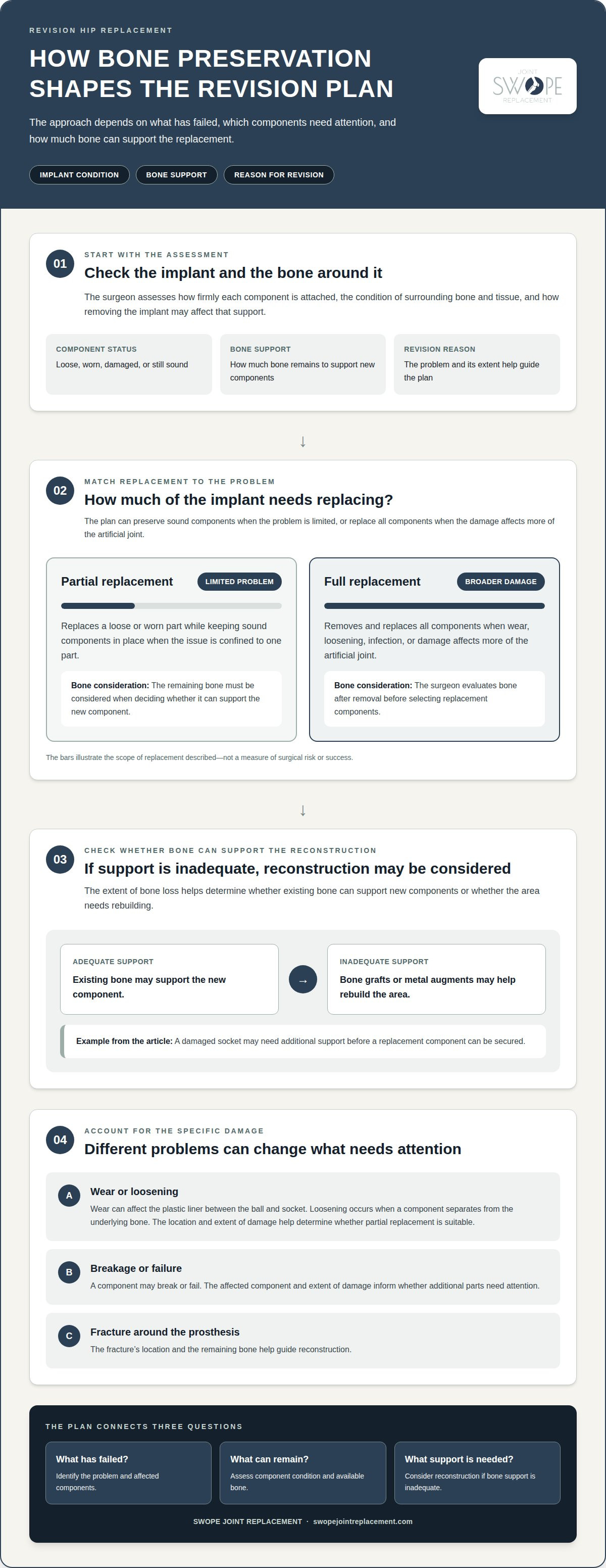
Revision planning considers how much of the existing implant needs replacement and how much bone can support new components. Bone quality, implant stability, and the reason for revision all shape these decisions.
Preserving Bone During Implant Replacement
Bone preservation starts with assessing the support around each component. A revision may replace only a loose or worn part, or remove the full prosthesis when damage affects the whole joint. The extent of bone loss helps determine whether existing bone can support new components or needs reconstruction.
During removal, the surgeon evaluates bone quality and the surrounding tissue. If bone loss leaves inadequate support, bone grafts or metal augments may help rebuild the area. For example, a damaged socket may need additional support before a replacement component can be secured. These decisions address the failed implant while accounting for the bone that remains.
Partial replacement keeps sound components in place when the problem is limited to one part. Full replacement removes and replaces all components when wear, loosening, infection, or damage affects more of the artificial joint. Either way, the plan accounts for the implant’s condition and available bone. If there is a fracture around the prosthesis, its location and the remaining bone also guide reconstruction.
Removing an older implant is more than exchanging parts. The surgeon assesses how firmly each component is attached to bone and how removal may affect that support. After removal, the bone and joint are evaluated before replacement components are selected. If the socket or femur lacks adequate support, grafting or augmentation may be considered as part of reconstruction.
Implant Wear, Loosening, and Breakage
Wear can affect the plastic liner between the ball and socket, while loosening occurs when a component separates from the underlying bone. A component may also break or fail. These problems can cause pain, instability, or reduced function. The location and extent of damage help determine whether partial replacement is suitable or additional components need attention.
Repeated high-impact activity and excessive body weight may contribute to implant wear or loosening. Wear of the plastic liner and osteolysis, or deterioration of bone around a prosthesis, can also weaken support. These factors alone do not establish the cause in an individual hip. They help focus the assessment on component condition, bone support, and activities associated with symptoms.
What are the success rates and outcomes of complex revision hip replacement? A single percentage does not capture outcomes across different causes and levels of bone damage. Outcomes are assessed through factors such as pain, implant stability, and hip function, while revision hip implants can last 15 years or longer with proper placement and care.
What is Revision Hip Replacement?
Revision hip replacement replaces part or all of an artificial hip joint. Unlike primary replacement, it addresses a prosthesis that has developed a problem after implantation. The plan depends on the cause, the affected components, and the condition of surrounding bone and tissue. A clear diagnosis helps define what the operation needs to address.
Common reasons for revision include a loose or worn component, repeated dislocation, infection, implant failure, or a fracture around the prosthesis. Osteolysis, the deterioration of bone around an implant, can also weaken support. Persistent pain after hip replacement may prompt an assessment, but pain alone does not explain its cause. The surgeon considers symptoms alongside examination findings and imaging.
Some cases require complex revision because the problem affects multiple components or has damaged the bone supporting them. Infection adds another consideration: the type of bacteria and the infection’s duration and severity affect treatment planning. A fracture around the implant also requires attention to its location, implant stability, and remaining bone. These details shape the proposed approach.
Before choosing a surgeon, ask how they’ll assess the cause of failure, which components may need replacement, and how bone loss or infection could affect the plan. Ask how they’ll explain potential risks, expected recovery, and alternatives in terms you understand. The answers can help you judge whether the plan addresses your specific hip and priorities.
The price depends on the case and is given after a quote request; factors include the extent of component replacement and reconstruction required. Insurance coverage depends on your plan, benefits, and out-of-network terms, so review how your policy treats the proposed procedure. Out-of-network insurance options may be relevant to that discussion.
Look for a surgeon experienced in evaluating and treating revision hip problems, including infection, fractures, component failure, and bone loss. Ask about their experience with cases like yours and how they’ll explain the reasoning behind the surgical plan. A specialist in complex revision hip surgery should clearly connect the diagnosis, implant choices, and likely recovery needs.
Preparation commonly includes detailed imaging, lab tests, and medical clearance. Imaging helps show implant position, bone condition, and any fracture; lab testing can contribute to an infection assessment. Medical clearance considers your overall health before surgery. The tests selected depend on the findings and the questions the surgical team needs to answer.
For a focused discussion of your diagnosis and treatment options, explore revision hip replacement care.
What is hip revision surgery?
Hip revision surgery replaces some or all components of an existing artificial hip. Recovery often takes longer than after primary replacement because the procedure can involve removing older components and rebuilding bone support. The recovery plan reflects the operation performed, your weightbearing instructions, and how your mobility progresses.
After surgery, a hospital stay commonly lasts 2 to 4 days. During this time, the care team monitors pain, wound healing, and early movement. Physical therapy supports strength and mobility through exercises suited to your procedure. A walker or crutches can help you move safely when weightbearing is restricted.
Restrictions depend on the reconstruction. Some patients need limited movement or weightbearing for 4 to 6 weeks, often using a walker or crutches. Your care team will explain which movements to avoid and when to progress activity. After revision hip replacement, common precautions include not bending the hip past 90 degrees or crossing the surgical leg.
Rehabilitation continues after discharge. Physical therapy helps restore strength, range of motion, and function through a personalized exercise program. Complete healing and mobility restoration can take 6 to 12 months. Progress is gradual, with the pace shaped by bone support, the components replaced, and any restrictions required after surgery.
At home, arrange help with daily tasks during early recovery. You may need assistance for days or weeks after returning home. Clear walking routes, secure rugs, and keep frequently used items within easy reach. A grab bar or elevated toilet seat can make routine movements safer while your mobility is limited.
Preventing complications also means following wound-care and movement instructions. Infection is a particular concern in revision care. For a two-stage exchange due to infection, the first operation removes the implant, cleans the bone, and places a temporary antibiotic spacer. A six-week course of intravenous antibiotics generally follows that first stage; reimplantation generally occurs 6 to 8 weeks after the initial operation.
No single hospital name establishes the right fit for every complex case. Focus on whether the surgeon treats revision problems such as infection, fracture, bone loss, or implant failure, and whether the proposed hospital plan addresses your specific reconstruction and recovery needs.
To find a specialist in complex revision hip surgery in the United States, look for an orthopaedic surgeon whose practice includes revision hip replacement. Ask how the surgeon plans the procedure, explains weightbearing limits, and coordinates rehabilitation. Clear answers can help you understand the path from hospital care through physical therapy and recovery at home.
Risks and complications
Revision hip surgery carries risks that deserve a direct, specific discussion before treatment. Compared with primary joint replacement, revision surgery has a higher risk of complications or chronic pain. The risks depend in part on the condition that prompted surgery and the reconstruction required.
Complications can affect the artificial joint, surrounding bone, or nearby tissues. For example, removing a loose component can leave weakened bone that needs additional support. Other risks include infection, dislocation, fracture, blood clots, or injury to nerves and blood vessels. Some patients also experience leg-length inequality, persistent pain, or loosening of replacement components.
Infection: Infection can involve tissue around the prosthesis. Its type, duration, and severity inform the treatment plan.
Fracture: Bone in the femur or pelvis can fracture during or after revision surgery.
Dislocation: The artificial joint can become unstable and move out of position.
Blood clots: Clots can form in leg veins after an operation.
Nerve or blood vessel injury: Nearby structures can be injured during complex reconstruction.
Ongoing symptoms: Surgery may not fully relieve pain, and implant wear or loosening can occur.
The extent of revision affects the challenges involved. Replacing one component differs from removing several components and rebuilding bone support. A fracture around an implant also changes the surgical considerations: its location, implant stability, and the remaining bone all matter. These details help the surgeon explain which risks are most relevant to your procedure.
Your health and the condition of your hip also shape risk. Infection requires attention to the bacteria involved and how long it has been present. Bone loss can affect how securely replacement components are placed. If the artificial joint has dislocated repeatedly, stability becomes an important part of planning. Each factor connects the reason for surgery to the treatment approach.
Before revision surgery, ask which complications are most relevant to your case and how the proposed plan addresses them. Ask what findings could change the operation, such as unexpected bone damage or evidence of infection. A clear discussion should distinguish risks that apply broadly from those linked to your implant, fracture, or medical history.
Recovery instructions matter, too. Follow the weightbearing and movement limits provided after surgery, since they reflect the reconstruction performed. Report concerns to your care team promptly, especially changes around the incision or a sudden change in hip function. Your team can explain which symptoms need attention and how follow-up will monitor healing, stability, and progress.
Factors that make revision surgery more complex
Revision hip replacement is more complex and time-consuming than primary hip replacement. The surgical plan must address both the failed artificial joint and the structures supporting it. For example, removing a loose component can reveal bone loss that affects how securely a replacement implant can be placed.
Bone and soft-tissue damage can limit the use of standard implants. The surgeon assesses how much support remains and whether reconstruction is needed before placing new components. Bone grafts or metal augments may help rebuild support when bone loss leaves the hip without a suitable foundation.
The number of components involved also matters. Replacing one worn part differs from removing an entire total hip prosthesis. A limited revision may focus on the affected component, while more extensive implant failure can require broader reconstruction. The extent of removal and the condition of the remaining bone shape the surgical work.
Several specific findings can add complexity:
Loosening: A component that has separated from bone may be difficult to remove without affecting existing support.
Repeated dislocation: Recurrent instability requires attention to the factors affecting joint stability.
Fracture: The fracture’s location, whether the implant is loose, and the remaining bone all influence treatment planning.
Infection: The bacteria involved, along with the infection’s duration and severity, affect the approach.
Bone loss: Osteolysis can weaken support around the prosthesis and complicate fixation of replacement components.
These factors can overlap. For instance, a fracture around a loose implant combines bone damage with a component that may not provide stable support. Infection can also require a staged approach rather than replacement in one operation. In these cases, the surgical plan must address the underlying problem and the steps needed to restore the hip joint.
Preoperative assessment helps define what the surgery will involve. Imaging shows the position of existing components and the condition of surrounding bone. Lab tests contribute to evaluating infection, while medical clearance informs preparation for surgery. Together, these findings help the orthopaedic surgeon plan component removal, reconstruction, and the support needed afterward.
A useful discussion connects each finding to a decision: which components need removal, how bone support will be addressed, and what could change the plan. This helps you understand why revision surgery differs from repeating the original procedure and which aspects of your case make it complex.
Discuss your revision hip surgery options and how the specific findings in your hip shape the surgical plan.
Swope Joint Replacement
Swope Joint Replacement provides revision hip replacement for patients facing implant failure, loosening, infection, or bone loss. If you’re considering another operation, a consultation can help clarify the problem, possible surgical approaches, and how your priorities inform treatment planning.
Care is delivered through a personalized concierge model, with direct physician access and clear discussions about your options. You can bring questions about the components involved, bone support, expected recovery, and out-of-network insurance. The aim is to help you understand the decisions ahead and take part in shaping a plan around your needs.
To discuss your revision hip concerns, contact Swope Joint Replacement.
Take the Next Step With Clarity
Choosing a specialist in complex revision hip surgery is a personal decision, and your priorities should guide the conversation. Use your next appointment to clarify what matters most, discuss any remaining questions, and understand how the proposed care fits your needs. You don’t need to have every decision made before starting that conversation.
Swope Joint Replacement provides orthopaedic care that includes Direct Anterior Hip Replacement, Knee Replacement, and Revision Hip Replacement. If you’re considering treatment for a complex hip problem, a discussion can help you explore the concerns you want addressed and the options that fit your situation.
Take the next step at a pace that feels right for you. Contact Swope Joint Replacement to begin a conversation about your care. A clear, thoughtful discussion can help you move forward with greater understanding and confidence.
Frequently Asked Questions
How long will the revision hip implant last?
A revision hip implant can last 15 years or longer with proper placement and care. Its lifespan depends on factors such as fixation, bone support, component wear, and the demands placed on the joint. Follow-up care helps monitor changes in comfort and function. New or increasing pain, instability, or difficulty with usual activities warrants assessment, but symptoms alone cannot show whether an implant needs revision.
How Soon Will I See Results?
Changes in pain and movement develop during recovery, rather than all at once. Early milestones may include moving safely with a walker or crutches and following weightbearing instructions. Physical therapy then works on strength, balance, and mobility. The pace depends on the reconstruction and your progress. Track changes in everyday tasks, such as standing from a chair or walking indoors, and discuss concerns at follow-up.
What Should I Expect During the Treatment?
Expect an assessment, a surgical plan, and a recovery plan tailored to the condition of your hip. Preparation can include imaging, lab tests, and medical clearance. Revision hip replacement is performed under general anesthesia and typically takes 2-3 hours, depending on implant removal and reconstruction. After surgery, the care team monitors your recovery and guides early movement. Ask how the planned procedure may affect your mobility and home routine.
What are the signs of needing a second hip replacement?
Increasing or persistent hip pain, repeated dislocation, or reduced function can signal a problem with an existing replacement. Other causes include implant wear or loosening, infection, and a fracture around the prosthesis. Pain or stiffness alone does not establish that another operation is needed. Assessment connects your symptoms with examination and imaging findings to help identify whether the implant, surrounding bone, or another cause is affecting the joint.
What does a complex revision hip surgeon specialize in?
A complex revision hip surgeon evaluates and treats problems affecting a previously implanted hip, including loosening, infection, fracture, and bone loss. The work can involve removing failed components, preserving or rebuilding bone support, and placing replacement parts. A specialist in complex revision hip surgery considers how these decisions fit together, helping you understand the reasoning behind the proposed approach and how it addresses the specific problem.
What are the risks and complications of complex revision hip surgery?
Risks include infection, dislocation, fracture, blood clots, nerve or blood vessel injury, leg-length inequality, and ongoing pain. Implant loosening or failure to attach securely to bone can also occur. The relevance of each risk depends on the reason for revision and the reconstruction involved. Ask which complications matter most in your case, how they could affect recovery, and which signs after surgery need prompt attention.
How does recovery and rehabilitation after complex revision hip surgery work?
Recovery combines movement precautions, weightbearing guidance, and physical therapy. Your instructions depend on the reconstruction, so follow the specific limits for walking and hip movement. A therapist can help you practise safe transfers, build strength, and progress exercises without exceeding those limits. Arrange practical help at home for tasks involving bending, carrying, or stairs, especially while using a walker or crutches.
Which hospitals and surgeons are recognized for complex revision hip replacement?
No single hospital name is the right fit for every complex case. Look for a surgeon experienced with revision problems involving infection, fractures, bone loss, or implant failure, and ask about their experience with cases like yours.
Comments